
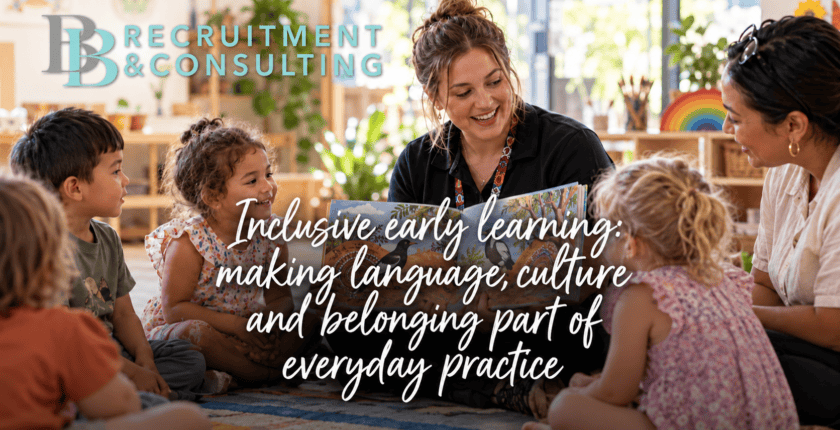
Inclusive early learning: making language, culture and belonging part of everyday practice.
A child hears a familiar word at arrival. A parent notices that an educator has remembered how to pronounce their child’s name. A family sees its everyday life reflected in a book.
These moments can help make an early learning setting feel familiar and welcoming. They also give childcare employers a useful starting point for thinking about inclusion.
For early learning services in Western Australia, supporting language, culture and belonging involves decisions about resources, relationships, routines and the support educators receive. It requires time to listen, reflect and put what is learnt into practice.
 Start with the everyday experience of belonging
Inclusion can be considered through a simple question: whose experiences are familiar within this environment, and whose are less visible?
Look at the books children can reach, the images at their eye level and the language used during everyday routines. Consider whether families have different ways to share information and whether educators feel comfortable asking respectful questions.
A resource may introduce a language or cultural perspective, but its value depends on how it is used. A book becomes more meaningful when an educator takes time to explore it with children, listens to their responses and connects the story to their lives.
The same care applies to names and home languages. Asking a family how to pronounce a child’s name, checking understanding and practising together can be a small but thoughtful act of professional care.
 Choose resources that invite recognition and curiosity
Thoughtful resources offer children opportunities to recognise their own lives and become curious about other people’s experiences.
For a WA service, this might include books showing different family structures, photographs of familiar local places, stories featuring people with disability, and materials that reflect both urban and regional life.
Review how people are represented. Do characters have varied interests, relationships and everyday experiences? Are cultural perspectives woven through the collection? Are resources accurate, respectful and suitable for the children using them?
Resources representing Aboriginal and Torres Strait Islander peoples require particular care about authorship, context and local relevance. Seek appropriate guidance rather than assuming one resource represents every community.
Employers can support this work by giving educators time to assess existing materials, identify gaps and explain the thinking behind proposed purchases.
 Build family partnerships through listening
Families hold knowledge about their children that a service cannot gather from an enrolment form alone.
A conversation might reveal the words a child uses for comfort, the people important to them, or a familiar routine that helps with transitions. Some families may welcome an invitation to contribute a story or song. Others may prefer a private conversation.
Offer choices and let families decide what they wish to share. No parent should feel responsible for representing an entire language, culture or community.
Useful questions include:
What would you like us to know about your child’s everyday life?
Are there words or familiar routines that help your child feel settled?
How would you prefer us to communicate with you?
Is there anything in our environment you would like us to understand differently?
The next step matters as much as the question. Explain how the information will be used, then return to the conversation as the child’s needs change.
 What thoughtful inclusion might look like in practice
Consider this illustrative scenario in a Perth early learning service.
A recently enrolled child watches group story time with interest but rarely joins the conversation. An educator speaks privately with the family and learns that the child enjoys telling stories at home in another language.
Together, they agree to try a familiar picture book. The family shares the pronunciation of a few words, and the educator uses pictures, gestures and small group reading to offer several ways to participate.
The team observes the child’s response over time and checks back with the family. They also consider whether the pace and format of group time give other children enough space to contribute.
There is no assumed outcome or single solution. The useful shift is in the team’s approach: they draw on family knowledge, adjust their practice and remain open to learning.
 Give educators time to reflect together
Inclusive practice asks educators to notice assumptions, discuss uncertainty and make considered decisions. Employers need to make room for that work.
A short, focused team discussion can begin with one observation:
Which children have clear opportunities to contribute during group experiences?
What have families shared that we have yet to act on?
Do our resources show people as individuals with varied lives?
Where would further guidance help us make a better decision?
Keep reflection constructive. Educators need to be able to ask questions and revisit a choice without feeling that every uncertainty is a personal failure.
External consulting support can be useful when a service needs help reviewing resources, facilitating reflection or identifying professional learning priorities. Give that support a clear purpose and connect it to everyday practice.
 Turn good intentions into one practical change
For childcare employers, a useful next step is to choose one part of the service experience and examine it closely.
Review the arrival routine. Look through the book collection. Revisit how family knowledge reaches the educators working with a child.
Listen to families and staff, agree on a manageable change, then return to it to see what has been learnt.
Language, culture and belonging take shape through repeated interactions. A thoughtful resource, a respectful question and a team willing to reflect can each make space for a child and family to feel more fully recognised.
To discuss recruitment or consulting support for your early learning service, contact BB Recruitment.
📧 enquiries@bbrecruitment.com.au
📞 08 6216 0014
🌐 linktr.ee/bbrecruitment