
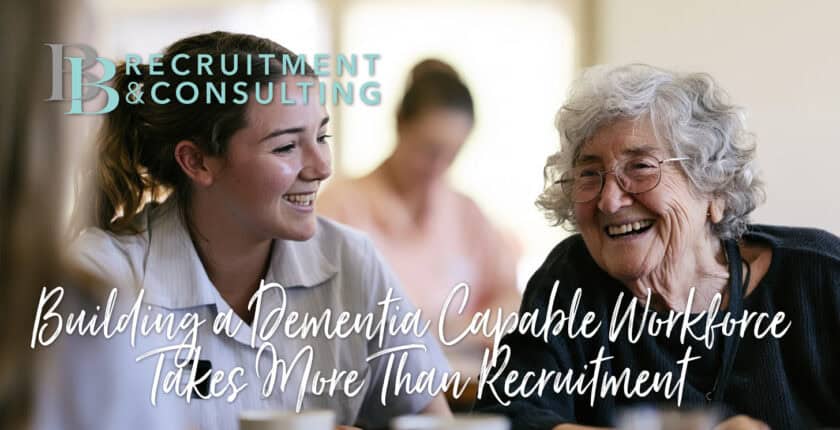
Building a Dementia Capable Workforce
Takes More Than Recruitment
For an employer, it can be tempting to treat dementia capability as a hiring requirement. Find someone with the right experience, fill the vacancy and trust that good care will follow.
Experience matters. But a worker’s ability to support a person living with dementia also depends on the training, time and guidance available in their workplace. Recruitment is the starting point. The team around that recruit helps determine whether their skills can be used well.
 Recruit for judgement and willingness to learn
Relevant qualifications and experience deserve careful attention. So do the qualities that are harder to capture in a job advertisement: patience, clear communication, respect for a person’s preferences and the judgement to ask for help.
An interview can explore these qualities through a practical question:
“A person you support seems distressed by a familiar routine. How would you respond, and who would you involve?”
The value lies in hearing how a candidate thinks, listens and works with others. Employers should also explain what support the role offers. A candidate needs an honest picture of the team they will join, the guidance available and how concerns are raised.
 Make training relevant to the people being supported
Induction provides a foundation, but questions often emerge during everyday care. A worker may understand a principle in training and still need help applying it with a particular person, family or care team.
Consider a community care worker in regional Western Australia who notices that a client has become unsettled during morning visits. A supportive workplace gives that worker a way to share the observation, learn more about the person’s preferences and discuss an appropriate response with colleagues.
This is an illustrative situation, not a BB Recruitment client story. It points to a practical management question: does the worker have time and a clear path to raise what they have noticed?
Training is most useful when employers identify the skills their team needs and give people opportunities to apply and discuss what they learn. Dementia Australia provides a training needs analysis tool, and the Australian Government’s Dementia Training Program offers education and professional development options for workers and providers. www.dementia.org.au
 Give leaders a visible role in care quality
Managers shape what happens after training. They decide whether staff can ask questions without embarrassment, whether observations reach the wider team and whether a worker receives support after a difficult shift.
That support should be part of ordinary practice. A useful handover might include what helps a person feel comfortable, how they prefer to communicate and what the team has noticed recently. Regular conversations give workers a chance to explain what is working and where they need help.
Leaders do not need to have every answer immediately. They do need to make it safe to seek an answer together.
 Look at the whole employment experience
A dementia capable workforce is built across the full employment experience, from the first conversation with a candidate to the support they receive months into the role.
For employers reviewing their approach, three questions offer a starting point:
- Recruitment: Are we assessing communication and judgement alongside qualifications and experience?
- Training: Do we understand our team’s learning needs, and can staff use what they learn in practice?
- Leadership: When a worker is uncertain or concerned, do they know who will listen and help?
People living with dementia deserve care that responds to them as individuals. Workers need a workplace that helps them provide it. Bringing recruitment, learning and leadership together gives both a stronger foundation.
If you are reviewing how you recruit and support your dementia care workforce, speak with BB Recruitment & Consulting.
📧 enquiries@bbrecruitment.com.au
📞 08 6216 0014
🌐 linktr.ee/bbrecruitment