
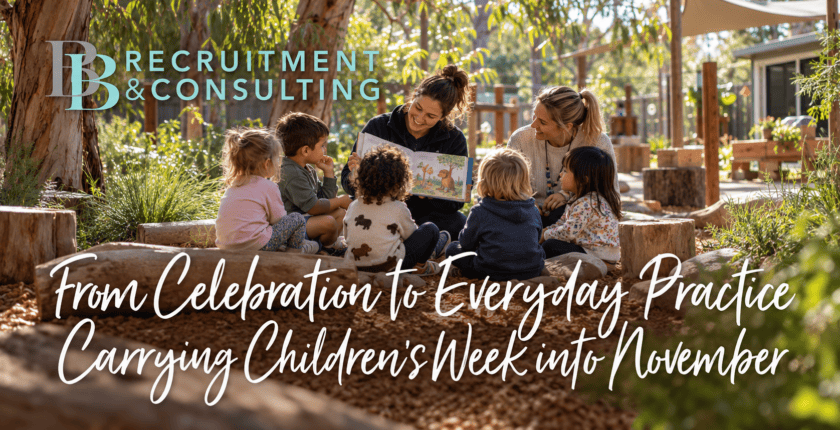
From celebration to everyday practice: carrying Children’s Week into November
Children’s Week can create space for conversations that a busy early learning day does not always allow. A family shares a familiar song. A child hears their home language recognised. An educator discovers something about a child’s life that changes how they welcome them the next morning.
As Children’s Week draws to a close, the question for childcare employers is what happens next.
The 2026 national theme centres on children’s right to their language, culture and religion. With the week ending on 1 November, this is a useful moment to consider how that focus can continue throughout the month.
For early learning services across Perth and regional Western Australia, the opportunity is practical: carry what you have learnt about children and families into the ordinary decisions that shape their experience of care.
 1. Make room for language in everyday relationships
Recognising a child’s language begins with curiosity about how their family communicates.
An educator might ask how to pronounce a child’s name, which words offer comfort, or whether there is a familiar song the child enjoys. Families can choose what they would like to share, without being expected to translate resources or teach the whole team.
Consider an illustrative Perth workplace scenario. During Children’s Week, a parent mentions a phrase their child uses when asking for help at home. With the family’s guidance, the room team learns to recognise it. In November, an educator hears the phrase during a difficult transition and responds with understanding.
The meaningful change is in the response. Something learnt during a celebration has become part of an everyday relationship.
For employers, a useful question is whether educators have a simple way to share this knowledge with colleagues, including relief staff, while respecting family privacy.
A brief, relevant handover can help a new person respond with greater understanding from their first day in the room.
 2. Let family perspectives influence what happens next
Inviting a family contribution is a beginning. Its value becomes clearer when it influences practice.
A conversation might prompt educators to reconsider which stories are available, how arrivals are supported or how families are invited into planning. Children can contribute too, through conversation, play, drawings, gestures and the interests they return to.
No family should be treated as the spokesperson for a whole culture. Families who share a language or background may have different beliefs, routines and preferences. Ask what matters to this child and this family.
For Aboriginal and Torres Strait Islander perspectives, begin with respectful local relationships. Seek guidance from appropriate local people, clarify permissions and discuss payment where cultural expertise is being requested. A resource used elsewhere may not be appropriate for the Country on which your service operates.
For services across WA, local context matters. The relationships and resources available in a Perth suburb may differ from those in a regional community. Start with the people connected to your service and listen before deciding what is needed.
Choose one contribution from Children’s Week and ask: what could we do differently because we listened?
 3. Give educators the support to respond thoughtfully
This work asks educators to listen carefully, reflect and exercise professional judgement. Employers need to make room for it.
Use an existing team conversation to discuss what children and families have shared. Identify a manageable change, agree who will support it and make relevant information accessible to the people who need it.
Avoid creating a separate reporting task for every interaction. Focus on information that helps educators understand children and respond thoughtfully.
Leaders can also make it comfortable to ask questions. An educator who is unsure about pronunciation, a family preference or the suitability of a resource needs a constructive place to seek guidance.
A useful leadership response might be: “Let’s check with the family rather than make an assumption.”
That approach gives educators permission to keep learning. It also recognises that respectful practice depends on ongoing relationships, with room for questions, corrections and reflection.
 4. Carry the approach into recruitment and induction
The way a service listens to families should be visible in how it welcomes new educators.
Recruitment conversations offer an opportunity to explore this. Ask candidates how they have listened to families and adapted their practice. Look for curiosity, respect and a willingness to learn, alongside the expertise the role requires.
A useful interview question is: “Can you describe a time when something a family shared changed your approach?”
Listen for a specific example. How did the educator respond? What did they reconsider? How did they respect the child and family’s preferences?
During induction, explain how your service builds family relationships, where relevant information is recorded and who can provide guidance.
Relief educators need this support too. A concise introduction to a child’s familiar routines, communication preferences and sources of comfort can give them a more thoughtful starting point.
For childcare employers, this connects recruitment with the everyday experience you want children and families to have.
 5. Choose one commitment to carry into November
A useful next step can be small enough to sustain.
Your team might improve the way family preferences are handed over, revisit a familiar book collection or introduce a regular opportunity for children to influence the learning environment.
Choose an action that responds to something you have actually noticed or heard.
If families have shared that arrival feels rushed, consider how a more welcoming conversation could fit into the morning. If children repeatedly return to a particular story, explore what holds their interest and whether they want to share something connected to it.
Agree who will support the change and when the team will revisit it. Be realistic about the time and resources available.
One thoughtful commitment, supported consistently, gives the team something concrete to learn from. It also makes it easier to notice whether the change is useful to children and families.
 6. Return to what children and families tell you
Later in November, return to the commitment your team chose.
Ask what educators noticed, whether families want to offer feedback and how children responded. Allow that reflection to shape the next step.
Feedback does not need to become another formal survey. A brief conversation at collection, a child returning to a familiar story or a family correcting an assumption can all offer something worth considering.
Give people space to disagree or change their preferences. What a family wanted to share during a celebration may be different from what they want included in everyday practice.
The aim is to keep learning about the people in your service, rather than treating one conversation as a complete picture of their lives.
The most useful legacy of Children’s Week may be a change that becomes so familiar it no longer feels like a special initiative: a name spoken with care, a family perspective remembered or a child’s idea taken seriously.
For childcare employers, the question is simple: what will children and families experience in November that shows their voices have stayed with us?
📧 enquiries@bbrecruitment.com.au
📞 08 6216 0014
🌐 linktr.ee/bbrecruitment