
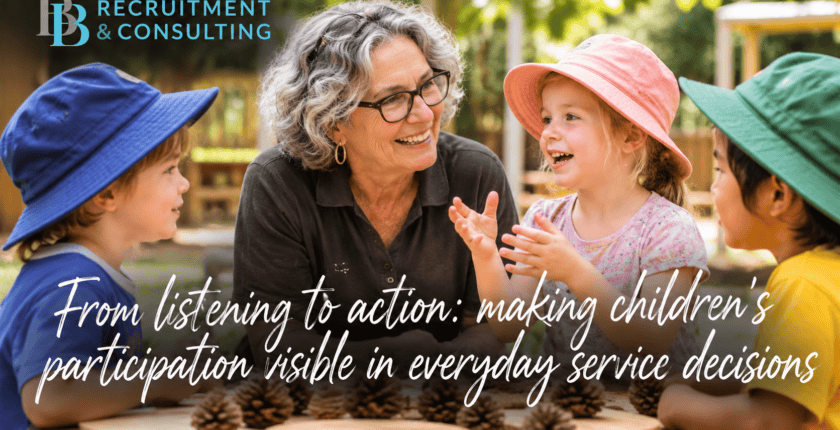
From listening to action: making children’s participation visible in everyday service decisions
Children’s participation is a fundamental part of quality early childhood education. Yet there is an important difference between listening to children and demonstrating that their perspectives genuinely influence decisions.
For early learning services, participation should extend beyond asking children what they would like to do. It means recognising their observations, preferences and ideas as valuable contributions to the learning environment, daily routines and educational programme.
For childcare employers and educational leaders, the challenge is to build participation into everyday practice so that it becomes part of the service culture rather than an occasional activity.
 1. Listening is only the beginning
Educators routinely observe children, respond to their interests and encourage them to express their views. However, meaningful participation requires another step: acting on what children communicate.
A child who suggests changing a play space, questions an established routine or proposes a different activity is contributing information that educators can use to improve the learning experience.
These contributions may be verbal, visual or expressed through behaviour and play. Younger children and those who communicate differently must have equally meaningful opportunities to influence decisions.
Educational leaders can support this by encouraging educators to consider not simply whether children were consulted, but what changed as a result.
 2. Make children’s influence visible in the learning environment
One of the clearest ways to demonstrate participation is through changes children can recognise.
A reading area might be reorganised following children’s suggestions. Outdoor resources might be relocated after educators observe how children use the space. A group discussion might lead to a new investigation or project.
These decisions do not need to be substantial to be meaningful.
Photographs, children’s drawings, learning documentation and conversations can help make the connection between children’s ideas and subsequent decisions visible.
The important question is whether children can recognise their own contribution and understand that their perspectives have been taken seriously.
 3. Give educators the time and confidence to respond
Meaningful participation depends on more than individual educator commitment. It requires leadership, appropriate staffing arrangements and a workplace culture that values professional judgement.
When educators are constantly responding to immediate operational demands, opportunities for extended conversations, reflection and collaborative decision-making can be lost.
Centre directors and educational leaders can strengthen participation by making space for educators to discuss children’s observations, review routines and consider how learning environments might be improved.
This also has implications for recruitment and workforce development.
Services benefit from educators who are curious, reflective, responsive and comfortable sharing decision-making with children. These capabilities deserve attention during recruitment, induction, mentoring and professional development.
 4. Build participation into everyday service decisions
Children’s participation should not depend on a particular educator, room or special project. It should be evident across the service.
Leadership teams can incorporate children’s perspectives into programme reviews, room planning, resource decisions and discussions about daily routines.
A practical starting point is to ask three questions during team reflection:
What have children communicated about their experiences?
What decisions have we made in response?
How have we shown children that their contributions mattered?
These questions can help teams move beyond documenting children’s voices towards demonstrating their influence.
They also provide a useful basis for continuous improvement, helping services examine whether participation is consistently supported across different age groups and learning environments.
From consultation to genuine participation
Children’s participation becomes meaningful when their perspectives help shape the environments, experiences and relationships that affect them.
For childcare employers, this requires more than an educational philosophy. It requires thoughtful leadership, capable educators and workplace practices that allow children’s ideas to influence decisions.
The goal is not to give children responsibility for every decision. It is to ensure they have genuine opportunities to contribute to decisions appropriate to their age, development and circumstances.
When services make that contribution visible, participation becomes part of everyday quality practice.
Supporting stronger childcare teams
BB Recruitment & Consulting works with early childhood education providers to support recruitment, workforce planning and practical leadership development. If your service is reviewing its staffing, educational leadership or approach to continuous improvement, we welcome the opportunity to discuss your needs.
📧 enquiries@bbrecruitment.com.au
📞 08 6216 0014
🌐 linktr.ee/bbrecruitment